Probate Help and Advice for London and England

October 12th, 2011

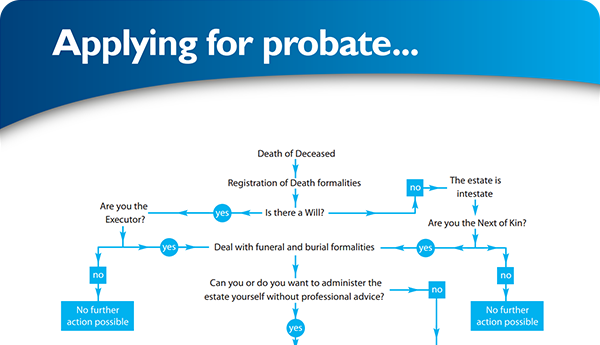
Dealing with the affairs of a deceased person can be complex and distressing and it can be hard to know where to start. Whether you are the next of kin or executor, the Probate Bureau can help you start the process or help you through every step of the way if you need it. The Probate Bureau offers probate help suitable for all situations. Getting some probate advice to determine whether you need a grant of probate or a letter of administration is the vital first step in ensuring that you carry out your role in the best way possible. If you live in or around London, the Probate Bureau can visit you in your own home or you can speak to one of our advisers free of charge on the telephone.

The legal process of administering a deceased estate, also called probate, involves sorting out money owing and distributing assets to the correct people. Probate can be lengthy and complicated whether or not the deceased has left a will.

Although it may seem hard to face, especially in times of bereavement, the faster that you obtain probate advice the easier it will be for you. For example, you may be able to defer the funeral expenses until money is released from the estate. This can be a huge headache for people who find themselves dealing with an unexpected death and lack the ready funds to pay for the funeral. Getting probate help will ensure that any expenses that you pay out will be reimbursed once the estate is distributed.

When a person dies, he or she leaves a range of issues that have to be dealt with, from the simple cancellation of a mobile phone contract and store card accounts, to the sale of a property and the disposal of the house contents. The Probate Bureau can arrange independent valuation and the sale of the property. In London, England especially the value of property can be high and subject to extreme fluctuations so it makes sense to ensure that the property is sold for correct market value. After all the deceased person would probably want to help his or her own family financially, and not an estate agent! 

In some cases where there is no close family, next of kin or will, you may find yourself as the nearest thing to a close relation or friend. In these cases, probate advice is essential. The Probate Bureau can help in verifying the family tree to determine where the funds of the estate should go. Whatever your situation, the Probate Bureau will provide you with a set fee for services that can be paid from estate proceeds, once it is resolved

The Probate Bureau offers a range of services that will give you real probate help. Professional probate advice can be as simple as just advising you whether you need a letter of administration or probate grant. It can be as complex as proving entitlement to the proceeds of a property sale. In London alone, thousands of people lose out each year by not taking the correct probate advice so make sure that this does not apply to you.

Share and Enjoy:
  • Digg
  • del.icio.us
  • Facebook
  • Reddit
  • StumbleUpon
  • Google Bookmarks
  • Twitter
  • Technorati
  • Live
  • LinkedIn
  • MySpace

Wills That Go The Extra Mile!

October 8th, 2011

Whilst most people write their Will simply to ensure their family are provided for and to stipulate their funeral wishes, others use it as a way of settling old scores or expressing their beliefs.

Below, we have picked some of the more colourful Last Wills and Testaments to have emerged to highlight just how powerful a Will can be:

  1. Famous British singer Dusty Springfield made sure that her cat was extremely well provided for in her Will. Strict instructions stated that he was only to be fed imported baby food and was to be serenaded with her records. It was even arranged that he would ‘marry’ his new guardian’s pet cat.
  2. 1960s rock icon Janis Joplin made changes to her Will just 2 days before her death from an overdose on 4th October 1970. Although the majority of her estate was left to her parents, she set aside $2,500 for an all-night party for 200 friends at her favourite pub so “my friends can all get blasted after I’m gone”.
  3. Arizona hermit and miner, James Kidd, went missing in 1949 and was legally declared dead in 1956. His Will was later discovered in 1963 which stipulated that his entire $275,000 estate was to be used to prove the existence of a human soul which leaves the body at death. More than 100 petitions for the inheritance were dismissed by the courts and it was awarded in 1971 to the American Society for Psychical Research. Disappointingly, they failed to prove the existence of a soul.
  4. The next Will is that of wealthy tanner John Bowman who outlived both his wife and two daughters. In the final years of his life, he became convinced that on his death his entire family would be reincarnated together. Due to this belief, he provided in his Will for a $50,000 trust fund to pay for the maintenance of his 21 bedroom mansion and mausoleum. Servants were left with instructions to prepare dinner for the family every night in case the family were hungry when they returned from the dead. After his death in 1891 his Will was honoured and the instructions were carried out until the trust fund ran out of money in 1950.
  5. Samuel Bratt is one man who used his Will to get even. In life, his wife never allowed him to smoke his favourite cigars. Embittered by this, in his Will he left his £330,000 estate to her, on the condition that she smokes five cigars a day for the rest of her life.
  6. In 1841, German poet Heinrich Heine married Eugenie Mirat, a clerk at a Parisian bootshop. In his Will, he left her everything on the condition that she remarry. His explanation for this was that “then there will be at least one man who will regret my death.”
  7. American radio personality Jack Benny had been married to his wife Sayde for 48 years when he died the day after Christmas in 1974. The day after his funeral, Sayde received a single, long-stemmed rose from a florist. She then received another the next day, and the day after that. Some people say she phoned the florist and demanded to know where the roses were coming from. However, it’s more likely that she just read his Will. In it Jack set aside money for a rose to be sent to her every day for the rest of her life, she lived another 9 years.
  8. The inventor of the Frisbee and sport ‘Disc Golf’, Ed Headrick, often joked to his son that he wanted to live on as a Frisbee after his death. No one took him seriously but he made it clear that he was not joking when he made his Will. After his death in 2002, his body was cremated and the ashes used to make a limited number of ‘memorial flying discs’ which were to be distributed amongst friends and family. Those left over were sold with the proceeds to go towards the creation of a ‘Frisbee and Disc Golf  history and memorabilia museum’.
  9. What would you do if you had few friends and no family? Would you leave your estate to charity? Well, Luis Carlos de Noronha Cabral da Camara, a wealthy Portuguese bachelor, decided to be a little more creative. Thirteen years before his death he made a Will leaving his entire estate to 70 strangers he randomly selected from the Lisbon phonebook. When contacted, most of them thought they were being scammed but each of them received several thousand pounds from the estate.
  10. Last on our list is British explorer Sir Walter Rayleigh, responsible for the introduction of tobacco in Europe. Aside from making bequests to relatives and charities he also included the following paragraph:

“I wish every smoker in the kingdom to be invited to my funeral in every way possible, by letter, circular and advertisement. Every smoker who takes advantage of the invitation shall receive as a present ten pounds of tobacco, and two pipes on which shall be engraved my name, my crest, and the date of my death. The poor of the neighborhood who accompany my bier shall receive every year on the anniversary of my death a large package of tobacco. I make the condition that all those who assist at my funeral, if they wish to partake of the benefits of my will, must smoke without interruption during the entire ceremony.”

In addition he requested that his coffin be lined with wood from his old Havana cigar boxes, and a package of French and Dutch tobacco be placed at the foot of his coffin. He also asked that a box of matches and his favorite pipe be left at his side.

Share and Enjoy:
  • Digg
  • del.icio.us
  • Facebook
  • Reddit
  • StumbleUpon
  • Google Bookmarks
  • Twitter
  • Technorati
  • Live
  • LinkedIn
  • MySpace

Do Probate Properties Sell for Less?

October 5th, 2011

It is a common misconception that probate properties sell for less than their market value. However, this is almost never the case. Whilst many believe that beneficiaries are will to accept a lower off in order to be able to finalise the probate process, in our experience this isn’t what happens.

An Executor of an Estate has a responsibility to ensure that they achieve the best possible price for all assets, including the property, which means a lower price cannot be accepted in order to speed up the probate process. Also, due to the current financial climate many beneficiaries want to ensure that they achieve the best price possible in order to ease their own financial burdens.

It must be noted that many bereaved client have an unrealistic idea of how much a property is worth as the sentimental value often means they believe it is worth much more than it is.

However, despite the fact that probae properties do not sell for less, the sale process is often done quicker as there is never a chain.

Share and Enjoy:
  • Digg
  • del.icio.us
  • Facebook
  • Reddit
  • StumbleUpon
  • Google Bookmarks
  • Twitter
  • Technorati
  • Live
  • LinkedIn
  • MySpace

Will overturned on a technicality

September 13th, 2011

The Daily Mail recently ran a story about a Sikh family’s dispute over their father’s Will.

Ranjit Singh died in his 70s and left a Will stipulating that almost his entire £870,000 estate be split between his 3 sons; leaving 2 of his daughters with just £40,000 between them. A third daughter was left nothing.

As a result, his daughter Balvinder Kaur Ahluwalia felt aggrieved enough to contest the Will and take the case to court.
One son, Jarnail Singh, argued that the Will reflected Sikh tradition which allows the eldest sons to take the main role within the family and that daughters were provided for through large wedding dowries earlier in life.

However, Mr Singh’s next door neighbour Maurice Grantham who witnessed the Will testified that neither he nor the other witness were present when Mr Singh signed it. This evidence had a strong bearing on the case, as for a Will to be valid, it must be signed by the testator in the presence of two unrelated witnesses.

Due to this technicality, the Will was declared invalid by the court and as a result the estate became an intestacy (this means all six children will now inherit in equal shares).

http://www.dailymail.co.uk/news/article-2034959/Daughter-overturns-fathers-870k-leaves-vast-estate-brothers.html

Share and Enjoy:
  • Digg
  • del.icio.us
  • Facebook
  • Reddit
  • StumbleUpon
  • Google Bookmarks
  • Twitter
  • Technorati
  • Live
  • LinkedIn
  • MySpace

What happens when an unknown family member comes to light after the estate has been distributed?

September 9th, 2011

It is the duty of the estate administrators to satisfy themselves that all family members have been identified in cases where the deceased died intestate. However, occasionally a family member that other relatives knew nothing about may get in touch after the estate has been distributed.

In these cases they are entitled to their inheritance even if the estate has already been distributed. All the other beneficiaries would be required to pay a portion of their inheritance to the new family member.

For this reason, it is normal practice for the estate administrator to ask beneficiaries to sign an indemnity agreeing that if any further family members come forward they will pay them the applicable portion from their share.  After a period of 10 years, it is unlikely that such a claim would be successful simply due to the amount of time that has passed.

In order to safeguard against issues such as this, it is possible to obtain suitable insurance.

Charlotte Cumbicus-Gunn
Probate Advisor

If you need further help or advice on dealing with estate administration or require more information on Probate or Wills in general, please call The Probate Bureau‘s free helpline on 0800 028 2837

Share and Enjoy:
  • Digg
  • del.icio.us
  • Facebook
  • Reddit
  • StumbleUpon
  • Google Bookmarks
  • Twitter
  • Technorati
  • Live
  • LinkedIn
  • MySpace