The Residuary Beneficiary/ies of an estate are those who inherit the balance of the funds after all pecuniary legacies and debts have been paid. Residuary Beneficiaries may be specifically named in a Will or, in intestacy cases, any relatives entitled to a share of the estate would be considered residuary beneficiaries.
Alternatively, if there is a Will and a specific amount (say £10,000) has been left to an individual or organisation, they are a ‘specific gift beneficiary’.
When writing a Will, it is advisable to make provisions in case one of your beneficiaries predeceases you, this involves naming an ‘alternate beneficiary’ who inherits in the place of the first named individual.
For more advice regarding writing your Will or interpreting a Will, please contact The Probate Bureau on 0800 028 2837.
A Will cannot literally be changed after death but as long as all beneficiaries are in agreement a Deed of Variation can be drafted which allows a ‘substituted Will’ to take priority over the original Will, essentially overriding it. This allows the beneficiaries to alter the distribution of the estate, for example by changing the amounts or the beneficiaries or leaving funds into Trust.
It is important to note that a Deed of Variation must be effected within 2 years of the date of death and that all beneficiaries are required to sign it, in order for it to be valid.
A Deed of Variation can also be useful when someone dies intestate and the family are unhappy with the estate being distributed via the Rules of Intestacy.
The Probate Bureau offers a professional Executor Will service and can arrange for a Deed of Variation. If this is something you would like to discuss further, please call Patricia directly, on 0800 028 2837 for free advice on a Deed of Variation.
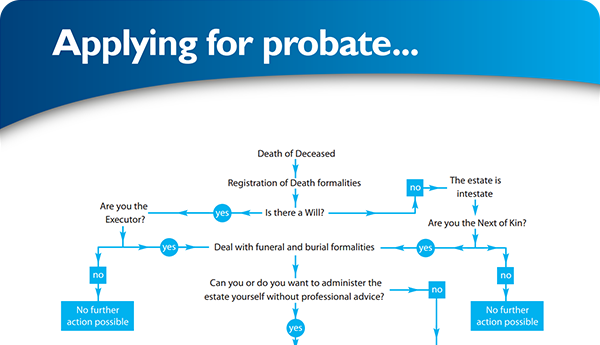
If you are administering an estate, it will usually be necessary to obtain a Grant of Representation which is also known as a Grant of Probate (if there is a Will) or a Grant of Letters of Administration (if there is no Will, i.e.; Intestacy).
Forms must be completed and submitted to the Probate Registry along with a covering letter stating where the Executor is to attend an interview.
For further details of your nearest Probate Registry office contact:
The Principal Registry of the Family Division First Avenue House
42-49, High Holborn
London WC1V 6NP
Tel: 020 7947 6939
Or find your local Probate office by viewing our useful numbers list.
If you would like more information on how to go about obtaining a Grant of Representation, Grant of Probate or Letters of Administration, please give The Probate Bureau a call on 0800 028 2837.
Sometimes a Grant of Representation is not needed and the Executors may wish to ask anyone holding the deceased’s money whether they will release it to the Executors without seeing a Grant of Representation. If they agree they may attach conditions. It is for the Executor to decide which is the cheaper or easier option. The following are examples of when a Grant of Representation may not be needed:
There are organisations who may release the money to the Executors without a Grant of Representation if the amount held is small and there are no complications. Among these are insurance Companies and Building Societies.
The Executor will not usually need a Grant of Representation when a house is held in joint names and it is clear that the house automatically becomes the property of the surviving owner. If the Executors are in doubt on this point they may need to ask a solicitor whether a Grant of Representation is needed to change the ownership. The Executor will need a Grant of Representation transfer or sell a property held only in the deceased’s name. A house must NOT be advertised for sale too soon after the owner’s death as a sale cannot be completed until the Executore have obtained the Grant of Representation. The date of issue of the Grant of Representation cannot be guaranteed to coincide with the final stages of any sale.
Inheriting a large amount of money is normally a positive experience and many people plan and look forward to using their new-found wealth. However, for people living on state benefits without any savings of their own it can cause worry and confusion.
Some benefits, such as the State Pension and Child Benefit, are universal. This means they are paid to all qualifying individuals regardless of wealth. These benefits would not be affected should you receive a large inheritance.
However, other benefits including Tax Credits, Income Support and Housing Benefit are means-tested and therefore only paid to people on a low income with savings below a certain amount. If you are in receipt of a means-tested benefit it is possible that it will be affected once you receive your inheritance.
As a benefits recipient, it is your responsibility to declare any change in circumstances to your local Job Centre. A Job Centre advisor would then be able to confirm which benefits would be affected by your inheritance.
The Probate Bureau cannot advise you regarding your benefits, however we are able to offer financial planning advice through TPB Financial Services who can assist you in investing your funds to meet your goals. To discuss this please contact James Hurdman on 0844 257 8290.
Recent Comments