


What is a grant of representation? A plain-English guide for families

A grant of representation is the legal document that gives someone the legal authority to deal with a person's money, property and possessions after they die. Most people simply call it "probate", and the document itself has a different name depending on whether the person left a valid will.
It is issued by the Probate Registry, which is part of HM Courts and Tribunals Service (HMCTS), and you apply for it in England and Wales. If you are an executor or a family member facing this for the first time, at what is already a difficult time, this guide covers the types of grant, who can apply, when you might not need one, what it costs and how long it takes. You can also read about our fixed fee probate service if you would like help with the probate application.
The three types of grant
"Grant of representation" is the umbrella term. GOV.UK, in its guidance on what happens after you have applied, names three documents, and which type of grant you receive depends on the circumstances.
| Document | When it is used | Who it is for |
|---|---|---|
| Grant of probate | There is a will and the executor can act | The executor named in the will |
| Letters of administration with will annexed | There is a will, but no executor is able to act | The person entitled to act in the executor's place |
| Letters of administration | There is no will | The administrator, usually the closest living relative |
An executor is the person named in a will to carry out its instructions. An administrator is the person who takes on that role when there is no will, or when no executor can act. Either way, the law calls them the personal representative. In practice, the three documents do the same job: they prove that the person named has the authority to administer the estate.
If you hear "grant of probate" and "grant of representation" used as if they mean the same thing, you are not far off. Probate is one type of grant, and the wider term covers all three. You may also hear a grant of letters of administration described simply as "letters".
Why a grant of representation is needed
The grant is the evidence that banks, building societies and other financial institutions rely on. Until they see it, most will not release funds held in the person's sole name, and a house in the deceased's sole name cannot be sold or transferred.
With the grant in hand, the executor or administrator can:
- close bank accounts and collect the money held in them
- cash in investments and shares, or transfer them to the beneficiaries
- sell or transfer property the deceased owned
- pay debts, bills and any inheritance tax due from the estate
- distribute what is left in accordance with the will or the rules of intestacy
Without it, the person dealing with the estate generally has no power to sign on its behalf. That is why the grant sits at the centre of the estate administration process.
Who can apply
Who applies depends on whether there is a will, according to GOV.UK's guidance on applying for probate.
- If there is a will: the executors named in it can apply. They are the people the person chose to carry out their wishes.
- If there is no will: the closest living relative can apply. A surviving spouse or civil partner usually comes first, and GOV.UK sets out the order of who comes next under the intestacy rules, such as children, then parents, then siblings.
The grant confirms who has authority to deal with the estate. It does not decide who inherits: that still follows the will or, if there is no will, the intestacy rules.
If more than one executor is named, they can apply together. An executor who does not want to act straight away can step back, which is known as having power reserved. They keep the right to apply later if needed. An executor who never wants to act can give up the role formally instead.
You do not have to apply on your own. Many people ask a professional to handle the application, particularly when the estate includes a property, or when family members are in different places.
When the person died intestate
When someone died intestate, meaning without a valid will, the person applying is the administrator rather than an executor. The rules of intestacy decide both who has priority to apply and who will inherit. If the closest relative does not want to act, the next person in line may be able to apply instead.
When you might not need one
Not every estate needs a grant. GOV.UK points out several situations where you may not need one, so check before you apply.
- The estate is made up of savings only. Some organisations will release small amounts of money without seeing a grant.
- Assets are jointly owned and pass automatically. For example, a joint bank account or a home owned as joint tenants usually passes to the surviving owner by survivorship. The surviving account holder normally just needs to show the bank a death certificate. Property or investments held in the person's sole name are more likely to need a grant.
- Each organisation has its own rules. Banks, building societies and other asset holders each set their own requirements, so it is wise to ask each of them what they need.
If you are unsure whether you need probate, the quickest route is to ask the organisations holding the assets, or to use the "Do I need probate?" form on our website.
What you need to do first
Before you apply, there is some groundwork. GOV.UK says you must value the estate first. That means finding out what the person owned and what they owed, including property, savings, investments and possessions. An estimated value is fine at the start, as long as you update it once you have the final figures.
If inheritance tax is due, GOV.UK says you must complete the IHT400 before applying for the grant. Many estates owe no tax, but you will still need to establish the value to know whether this applies, and to know whether the estate is above the inheritance tax threshold.
A sensible order of work looks like this:
- Find the original will, if there is one, and confirm who the executors are.
- Get the death certificate and list the assets and the debts.
- Contact banks, pension providers, the employer if the person was still working, and other organisations for balances, then work out the value of the estate, including the property.
- Check whether inheritance tax is due and, if so, deal with the IHT400 and any tax matters with HMRC.
- Make the application for the grant, online or by post.
How to apply for a grant
Most people now make the application online through GOV.UK. You can apply by post using a paper form instead, but the online route is generally quicker to complete. Professional firms submit applications through their own online system.
The person applying will be asked for details of the deceased, the estate's value, the will and any codicils, and the executors or administrators. You will also need to send the original will to the Probate Registry. You then sign a statement of truth confirming that the information is correct, so it is important to check every detail before you submit.
If there is a dispute, or someone has concerns about the will, they can enter a caveat at the Probate Registry. A caveat stops a grant being issued for a period while the matter is looked at. Most families never need to think about this, but it is useful to know it exists.
How much it costs and how long it takes
The court fee for a grant is £526 if the estate is worth more than £5,000, according to GOV.UK's probate fees page. There is no application fee if the estate is worth £5,000 or less. The fee is paid when you apply and can normally be repaid from the estate if an executor covers it at first. Official copies of the grant cost £2 each if you order them with your application, or £16 each if you order them afterwards. It is cheaper to work out how many you need before you apply.
You may still see older figures quoted online, such as £215. Fees change, so always check the GOV.UK page for the current amount before you budget. Professional fees, if you use a firm to help, are separate from the court fee.
On timing, GOV.UK says you usually receive the grant within 12 weeks of applying. That is a general guide: straightforward estates may move faster, complex estates can take longer, and delays can happen if there are errors or missing information, which is another reason to prepare carefully.
What happens once the grant is issued
When the grant arrives, check that the details are correct. GOV.UK explains that errors should be returned to the probate registry named on the document.
Two things to be aware of:
- The will becomes a public record. Once the grant is issued, the will can be seen by others. If privacy is a concern for your family, it helps to know this in advance.
- You send copies to the organisations holding assets. Banks and other asset holders will want to see a copy of the grant before they release money or transfer assets. This is why ordering enough official copies at the outset saves money.
After that, you can start dealing with the estate. That means collecting the assets, paying any debts and taxes, and passing on what is left to the people entitled to it. Utility companies, pension providers and other creditors will also need to be told about the death and paid what they are owed. Because the grant shows who is entitled to act, it also protects the executors and the organisations that deal with them. It is common to prepare estate accounts, showing what was collected, paid out and distributed, before the estate is finalised.
The personal representative's responsibilities
Taking out a grant of representation is the start of the job, not the end. The personal representative is responsible for dealing with the estate carefully and honestly, keeping clear records, and making sure debts and tax are paid before the beneficiaries receive their inheritance.
If an executor distributes the estate too early and a debt or claim later comes to light, they can be personally at risk. That is one reason many families take advice, especially for complex estates, estates with property to be sold, or where beneficiaries do not agree.
Getting help with the application
You can apply for a grant yourself, but many families prefer to have support. Our fixed fee probate service can obtain the grant for you from £950 + VAT. If you would rather have the whole estate looked after, we can handle the full administration for a fixed fee that is quoted on request.
The court fee is a separate cost. Our team can talk you through what you will need to pay before you commit to anything.
Ready to start? We can help
If you would rather not apply alone, our fixed fee probate service can obtain the grant for you, from £950 + VAT, or handle the full estate for a fixed fee quoted upfront. Use our "Do I need probate?" form, request a callback or call 0800 028 2837.
Key takeaways
- A grant of representation is the court document that lets someone deal with an estate.
- It is called a grant of probate if there is a will, or letters of administration if there is not.
- The GOV.UK fee is £526 for estates over £5,000.
- Grants are usually issued within 12 weeks of applying.
- Some small or jointly owned estates do not need one.
Frequently asked questions
Is a grant of representation the same as probate?
Nearly. Probate is the everyday name for the process, and a grant of probate is one type of grant of representation. The wider term also covers letters of administration, which are used when there is no will or no executor able to act.
How long does a grant of representation take?
GOV.UK says you usually receive the grant within 12 weeks of applying. Errors or missing information can slow things down, so it pays to check your application carefully before you send it.
How much does a grant of representation cost?
The court fee is £526 if the estate is worth more than £5,000. Official copies cost £2 each with your application or £16 each afterwards. If you use a professional to help, their fees are additional, and the Probate Bureau's grant service starts from £950 + VAT.
Do I always need a grant of representation?
No. It depends on what the person owned and on the rules of each organisation holding their assets. Savings-only estates and jointly owned assets that pass automatically may not need one, so ask each organisation what it requires.
Who can apply for a grant of representation?
If there is a will, the executors named in it can apply. If there is no will, the closest living relative can apply. You can also ask a professional to make the application on your behalf.
When is a grant of representation needed?
A grant of representation is needed when an organisation holding the deceased person's assets asks for one before it will release them. This is usually the case for property in the person's sole name and for larger bank or investment balances.
Useful resources
- GOV.UK, Applying for probate
- GOV.UK, Probate application fees
- GOV.UK, What happens after you have applied
- GOV.UK, Valuing the estate of someone who died
Share This Post


Recent posts
- What is a deed of variation and when does it make sense? By Probate Bureau , 26/11/2026
- What does a grant of probate look like, and who needs a copy? By Probate Bureau , 26/11/2026
- Probate property valuations: how to get it right first time By Probate Bureau , 25/11/2026
2015 Archive
2016 Archive
2018 Archive
2019 Archive
2020 Archive
2026 Archive
2023 Archive
- July 13 posts
0 Archive
- December 1 posts
Blog Categories
Find your way through the probate maze
Click here to follow our step-by–step probate process guide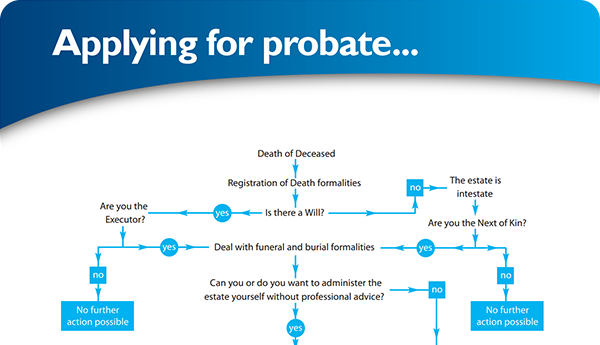
Testimonials
Excellent service, everything went very smoothly. Like to thank Ann and her team.... read more
Good & Reliable service, always kept up to date with what was happening. Value for money.... read more
Latest Tweet
Follow @ProbateBureau


Contact Us
0800 028 2837 info@probatebureau.comTHE PROBATE BUREAU
3 Crane Mead Business Park
Crane Mead
Ware
Hertfordshire
SG12 9PZ
×